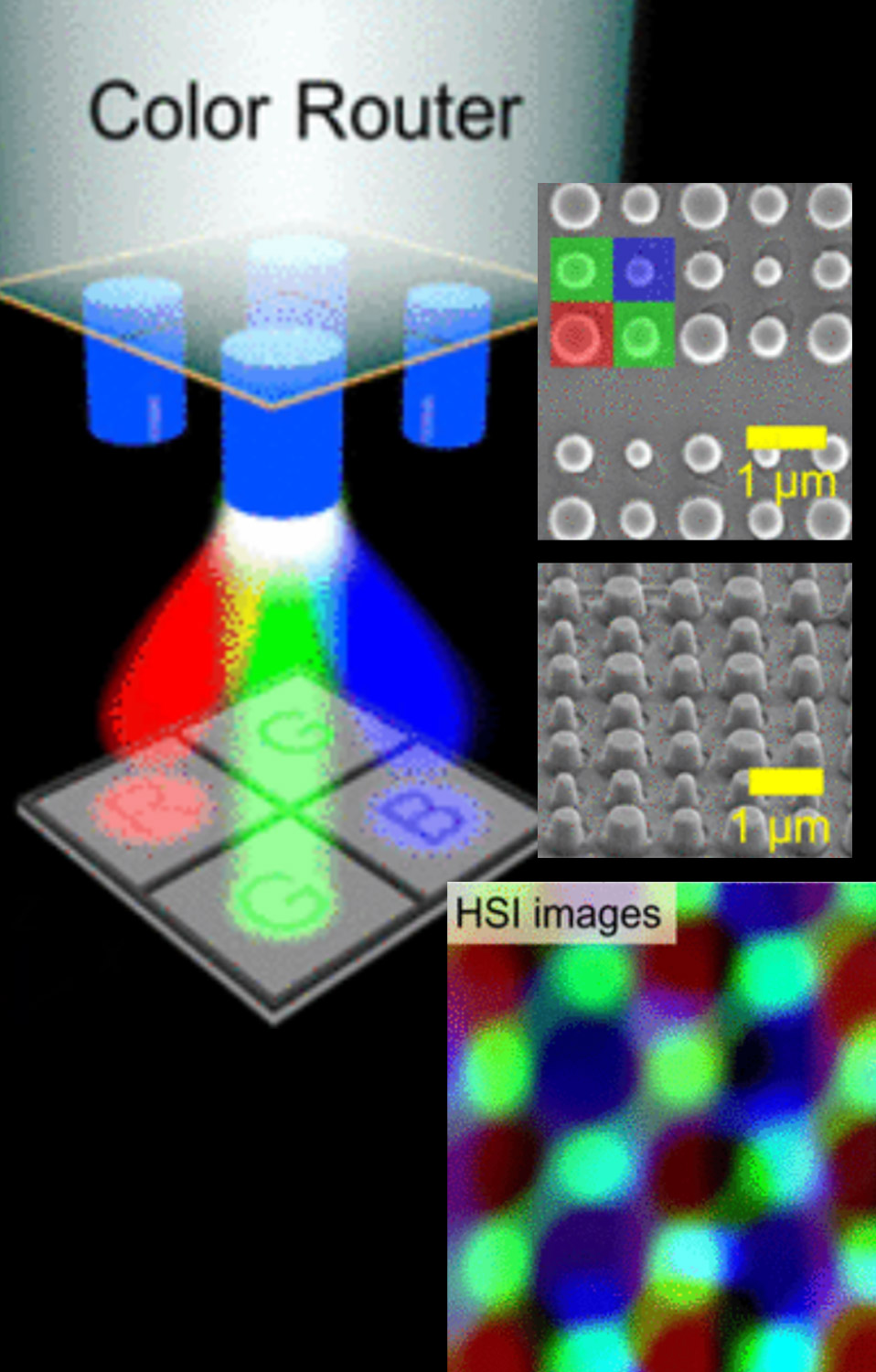
As CIS pixel sizes continue to shrink, the goal is to achieve higher spatial resolution, smaller device size, and lower cost. However, reducing pixel size decreases the light-receiving area of each pixel, directly leading to a decline in optical sensitivity. Additionally, traditional dye-based color filters, which are about 200 nm thick, occupy space in miniaturized pixels and limit the flexibility of optical design.
Metasurface Color Splitter Solution :
Our metasurface technology offers a solution to these challenges: No Sensitivity Sacrifice: Unlike microlenses, the metasurface color splitter works by redirecting light to specific pixels, thereby preserving optical sensitivity.
Minimalist Structure, Efficient Spectral Splitting: We use an ultra-simple design where each pixel requires only a single nanopillar.
High Efficiency: Each nanopillar acts as a near-field directional scatterer. It redirects unwanted light from one pixel to adjacent target pixels, allowing each pixel to gain additional light energy from its neighbors. Experimental Data: Compared to the ideal efficiency without a color splitter, our structure has been experimentally verified to improve efficiency by 152%, 180%, and 120% at wavelengths of 633 nm (red), 532 nm (green), and 480 nm (blue), respectively. Process Compatibility: Our single-layer nanopillar design is easy to manufacture and compatible with standard CIS pixel sizes.