
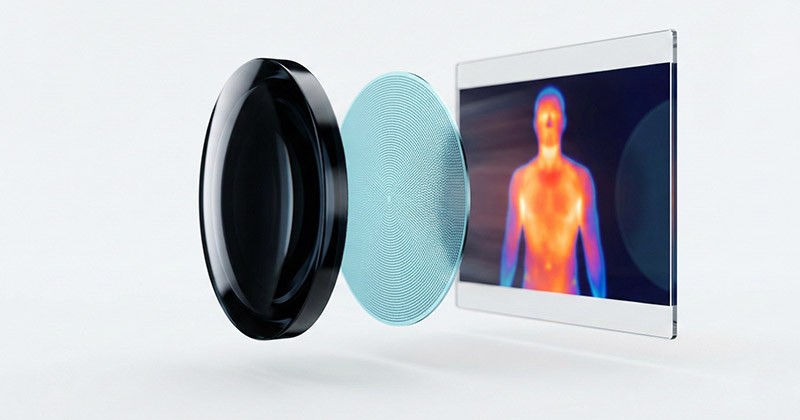
LWIR (8-12μm)
LWIR metalenses feature ultra-thin, lightweight, and mass-producible advantages, demonstrating high value across defense, commercial, and automotive thermal imaging applications. In defense scenarios, they offer high-efficiency imaging performance in the long-wave infrared band, delivering clear thermal images under nighttime, smoke, dust, and harsh weather conditions. This capability supports reconnaissance, target identification, terrain monitoring, and battlefield situational awareness. Compared with conventional infrared lenses, metalenses significantly reduce UAV payload weight, lower power consumption, and extend flight endurance, upgrading military UAVs in mission flexibility, stealth, and reliability.
In commercial thermal imaging, LWIR metalenses provide a slim and cost-effective optical solution that enables device miniaturization and easier integration into various platforms. They are widely applicable to industrial inspection, power grid monitoring, and agricultural surveillance, and can also be deployed on production lines for real-time detection of hotspot defects in solar panels or circuit boards. Their ultra-compact form factor saves valuable production-line space and enhances automated inspection efficiency.
In automotive applications, LWIR thermal imaging lenses are used for night driving assistance, pedestrian recognition, and animal detection. Traditional thermal lenses are bulky and expensive, limiting widespread adoption. In contrast, silicon-based metalenses can be fabricated using semiconductor processes, enabling true mass production and significantly reducing cost, making thermal imaging lenses easier to integrate into vehicle systems and positioning them as a key optical component for intelligent driving and advanced driver-assistance systems (ADAS).